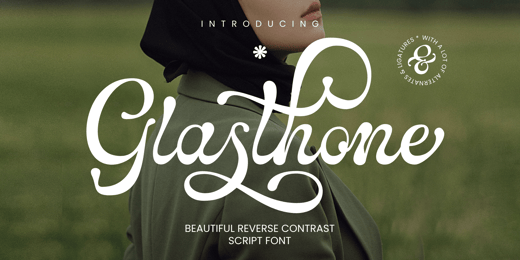
Language / Feature Options

Close

OpenType Pro (CFF)

- Font contains extended typographic feature capabilities.

Features

  • liga

    Standard Ligatures

    Tag:: liga

    Function:: Replaces a sequence of glyphs with a single glyph which is preferred for typographic purposes. This feature covers the ligatures which the designer/manufacturer judges should be used in normal conditions. The glyph for ffl replaces the sequence of glyphs f f l.

  • sups

    Superscript

    Tag:: sups

    Function:: Replaces lining or oldstyle figures with superior figures (primarily for footnote indication), and replaces lowercase letters with superior letters (primarily for abbreviated French titles). The application can use this feature to automatically access the superior figures (more legible than scaled figures) for footnotes, or the user can apply it to Mssr to get the classic form.

  • swsh

    Swash

    Tag:: swsh

    Function:: This feature replaces default character glyphs with corresponding swash glyphs. Note that there may be more than one swash alternate for a given character. The user inputs the ampersand character when setting text with Poetica with this feature active, and is presented with a choice of the 63 ampersand forms in that face.

  • salt

    Stylistic Alternates

    Tag:: salt

    Function:: Many fonts contain alternate glyph designs for a purely esthetic effect; these don't always fit into a clear category like swash or historical. As in the case of swash glyphs, there may be more than one alternate form. This feature replaces the default forms with the stylistic alternates. The user applies this feature to Industria to get the alternate form of g.

  • subs

    Subscript

    Tag:: subs

    Function:: The "subs" feature may replace a default glyph with a subscript glyph, or it may combine a glyph substitution with positioning adjustments for proper placement. Recommended implementation: First, a single or contextual substitution lookup implements the subscript glyph (GSUB lookup type 1). Then, if the glyph needs repositioning, an application may apply a single adjustment, pair adjustment, or contextual adjustment positioning lookup to modify its position.

  • titl

    Titling

    Tag:: titl

    Function:: This feature replaces the default glyphs with corresponding forms designed specifically for titling. These may be all-capital and/or larger on the body, and adjusted for viewing at larger sizes. The user applies this feature in Adobe Garamond to get the titling caps.

  • dlig

    Discretionary Ligatures

    Tag:: dlig

    Function:: Replaces a sequence of glyphs with a single glyph which is preferred for typographic purposes. This feature covers those ligatures which may be used for special effect, at the user's preference. The glyph for ct replaces the sequence of glyphs c t, or U+322E (Kanji ligature for "Friday") replaces the sequence U+91D1 U+66DC U+65E5.

  • ccmp

    Glyph Composition/Decomposition

    Tag:: ccmp

    Function:: To minimize the number of glyph alternates, it is sometimes desired to decompose a character into two glyphs. Additionally, it may be preferable to compose two characters into a single glyph for better glyph processing. This feature permits such composition/decompostion. The feature should be processed as the first feature processed, and should be processed only when it is called. In Syriac, the character 0x0732 is a combining mark that has a dot above AND a dot below the base character. To avoid multiple glyph variants to fit all base glyphs, the character is decomposed into two glyphs...a dot above and a dot below. These two glyphs can then be correctly placed using GPOS. In Arabic it might be preferred to combine the shadda with fatha (0x0651, 0x064E) into a ligature before processing shapes. This allows the font vendor to do special handling of the mark combination when doing further processing without requiring larger contextual rules.

  • pcap

    Petite Capitals

    Tag:: pcap

    Function:: Some fonts contain an additional size of capital letters, shorter than the regular smallcaps and whimsically referred to as petite caps. Such forms are most likely to be found in designs with a small lowercase x-height, where they better harmonise with lowercase text than the taller smallcaps (for examples of petite caps, see the Emigre type families Mrs Eaves and Filosofia). This feature turns lowercase characters into petite capitals. Forms related to petite capitals, such as specially designed figures, may be included. The user enters text as lowercase or mixed case, and gets petite cap text or text with regular uppercase and petite caps. Note that some designers, might extend the petite cap lookups to include uppercase-to-smallcap substitutions, creating a shifting hierarchy of uppercase forms.


Languages

  • Basic Latin

    These fonts support the Basic Latin character set. Each font is Unicode™ encoded, and available in d

    Tag:: Basic Latin

    Function:: These fonts support the Basic Latin character set. Each font is Unicode™ encoded, and available in different formats. Please review the product information for each font to ensure it will meet your requirements.

$63.00
Select Selected


OpenType Pro (TTF)

- Font contains extended typographic feature capabilities.

Features

  • liga

    Standard Ligatures

    Tag:: liga

    Function:: Replaces a sequence of glyphs with a single glyph which is preferred for typographic purposes. This feature covers the ligatures which the designer/manufacturer judges should be used in normal conditions. The glyph for ffl replaces the sequence of glyphs f f l.

  • sups

    Superscript

    Tag:: sups

    Function:: Replaces lining or oldstyle figures with superior figures (primarily for footnote indication), and replaces lowercase letters with superior letters (primarily for abbreviated French titles). The application can use this feature to automatically access the superior figures (more legible than scaled figures) for footnotes, or the user can apply it to Mssr to get the classic form.

  • swsh

    Swash

    Tag:: swsh

    Function:: This feature replaces default character glyphs with corresponding swash glyphs. Note that there may be more than one swash alternate for a given character. The user inputs the ampersand character when setting text with Poetica with this feature active, and is presented with a choice of the 63 ampersand forms in that face.

  • salt

    Stylistic Alternates

    Tag:: salt

    Function:: Many fonts contain alternate glyph designs for a purely esthetic effect; these don't always fit into a clear category like swash or historical. As in the case of swash glyphs, there may be more than one alternate form. This feature replaces the default forms with the stylistic alternates. The user applies this feature to Industria to get the alternate form of g.

  • subs

    Subscript

    Tag:: subs

    Function:: The "subs" feature may replace a default glyph with a subscript glyph, or it may combine a glyph substitution with positioning adjustments for proper placement. Recommended implementation: First, a single or contextual substitution lookup implements the subscript glyph (GSUB lookup type 1). Then, if the glyph needs repositioning, an application may apply a single adjustment, pair adjustment, or contextual adjustment positioning lookup to modify its position.

  • titl

    Titling

    Tag:: titl

    Function:: This feature replaces the default glyphs with corresponding forms designed specifically for titling. These may be all-capital and/or larger on the body, and adjusted for viewing at larger sizes. The user applies this feature in Adobe Garamond to get the titling caps.

  • dlig

    Discretionary Ligatures

    Tag:: dlig

    Function:: Replaces a sequence of glyphs with a single glyph which is preferred for typographic purposes. This feature covers those ligatures which may be used for special effect, at the user's preference. The glyph for ct replaces the sequence of glyphs c t, or U+322E (Kanji ligature for "Friday") replaces the sequence U+91D1 U+66DC U+65E5.

  • pcap

    Petite Capitals

    Tag:: pcap

    Function:: Some fonts contain an additional size of capital letters, shorter than the regular smallcaps and whimsically referred to as petite caps. Such forms are most likely to be found in designs with a small lowercase x-height, where they better harmonise with lowercase text than the taller smallcaps (for examples of petite caps, see the Emigre type families Mrs Eaves and Filosofia). This feature turns lowercase characters into petite capitals. Forms related to petite capitals, such as specially designed figures, may be included. The user enters text as lowercase or mixed case, and gets petite cap text or text with regular uppercase and petite caps. Note that some designers, might extend the petite cap lookups to include uppercase-to-smallcap substitutions, creating a shifting hierarchy of uppercase forms.


Languages

  • Basic Latin

    These fonts support the Basic Latin character set. Each font is Unicode™ encoded, and available in d

    Tag:: Basic Latin

    Function:: These fonts support the Basic Latin character set. Each font is Unicode™ encoded, and available in different formats. Please review the product information for each font to ensure it will meet your requirements.

$63.00
Select Selected