
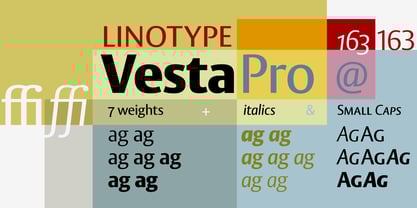
Vesta™
- Designer Gerard Unger
- Design foundry Linotype
- Source Linotype
Vesta’s stroke terminals taper almost to a point where they join main strokes. This gives a sparkle and liveliness to the letters when they’re set large, and makes them especially easy to distinguish when set in text sizes. In addition, Vesta has slightly narrower proportions than most sans serif typefaces, making it space economical.
Vesta History
There is little that’s traditional about Gerard Unger’s Vesta™ typeface, though its origins are noble. In 1998, Unger accepted the commission to develop a typeface for signage and wayfinding for Rome’s Jubilee 2000 celebration. He based his initial design on the precursors of imperial Roman capitals. When the Jubilee’s organizing committee decided to use a serif typeface instead, Unger proceeded to develop Vesta – named after the Temple of Vesta at Tivoli, reported to be the ancestral home of all sans serif typefaces.
Unger sums up his final design, which also includes a surprising French influence: “It’s rare for a sans serif typeface to have Vesta’s outspoken difference between thick and thin parts. French typeface designs of the late 1940s and 1950s – notably Chambord by Roger Excoffon – were my inspiration for the stressed strokes.”
Both Vesta and Big Vesta are available in seven weights, ranging from an elegant light to an authoritative black – each with a complementary cursive italic. To supplement the large Pro font character set, which supports most Central European and many Eastern European languages, the Vesta family also includes small caps and old style figures.