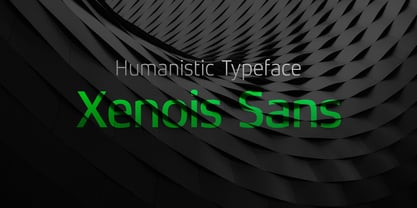
Xenois™ Sans
- Designer Erik Faulhaber
- Design foundry Linotype
- Source Linotype
“Drawing letters is my passion,” says Erik Faulhaber, the designer of the Xenois typeface family. Pronounced “zeeno-is,” the design distills character shapes into what Faulhaber believes are their purest forms. “I studied many typefaces, carefully examining their structure, before I began drawing Xenois. Then I actually wrote out a detailed design brief establishing the goals for my design.”
History of the Typeface
About the Designer
Faulhaber studied design in Karlsruhe at the Center for Art and Media under Professor Kurt Weidemann. “I’ve been fascinated by letters for as long as I can remember,” Faulhaber recalls. “When I was a child, the letters on a book cover, a poster or a truck tarpaulin made a strong impression on me. I found their shapes irresistible, and I fell in love with them.”
After graduating, Faulhaber worked briefly at Linotype outside Frankfurt, and in 1996 embarked on his career as an independent designer. Faulhaber has taught typography at the universities of Halle, Weimar and Wuppertal.
Design Traits
Xenois is more than a simple type family. This far-reaching suite of designs provides solutions for a multitude of communications. The mission Faulhaber set for himself was more extensive than designing a new original typeface and more laborious than creating several individual type families. His task was a combination of these – and then some. The sub-families within the Xenois series interrelate perfectly. They have a common and obvious design bond, yet each is able to stand on its own as a distinct typestyle. The Xenois typefaces are based on a common underlying model; they have the same cap height, the same lowercase x-height, the same stem weights, and the same basic character shapes. This unity of shape and proportion results in a remarkably complementary set of typeface designs.
All the Xenois designs are distinguished by a large lowercase x-height, squared character shapes, somewhat wide proportions and full, open counters. Each sub-family is comprised of five weights from light to heavy, and all have companion italics. Faulhaber not only simplified the sans serif characters, but also did away with many traditional serifs – leaving only those that make reading easier.