
Select this license type when you are developing an app for iOS, Android, or Windows Phone, and you will be embedding the font file in your mobile application's code.
Centaur®
by Monotype
Individual Styles from $29.99
Complete family of 4 fonts: $132.99
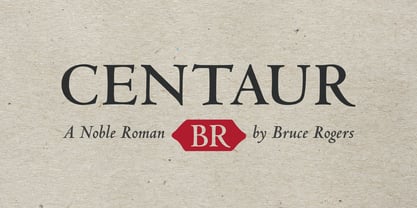
Centaur Font Family was
designed by
Frederic Warde,
Bruce Rogers and
published by
Monotype. Centaur contains
4
styles and family package options.
More about this family
- Aa Glyphs
-
Best ValueFamily Packages
- Individual Styles
- Tech Specs
- Licensing
Per style:
$33.24
Pack of 4 styles:
$132.99
About Centaur Font Family
A refinement of Roman inscriptional capitals designed by Bruce Rogers as a titling design for signage in the Metropolitan Museum. Rogers later designed for the Monotype Corporation a lowercase based on Jenson’s work, turning the titling into a full typeface, Centaur, the most elegant and Aldine of the Jenson derivatives.
Centaur® font field guide including best practices, font pairings and alternatives.
Designers: Frederic Warde, Bruce Rogers
Publisher: Monotype
Foundry: Monotype
Design Owner: Monotype
MyFonts debut: null
Centaur®
is a trademark of The Monotype Corporation registered in the United States Patent and Trademark Office and may be registered in certain other jurisdictions.

About Monotype
The Monotype Library is one of the world’s largest and most comprehensive collection of typefaces, featuring original designs of historical importance and a fresh range of contemporary and fashionable fonts. The Monotype Library includes thousands of timeless classics, hand-crafted revivals and original designs from many of the most innovative type designers and foundries in history. This distinctive, award-winning library of premium fonts provides brands and designers with a broad and reliable selection of typefaces for expressive typography in print and on screen. The Premium Foundry page can be viewed Here.
Read more
Read less
- Choosing a selection results in a full page refresh.